


Page 18 - 2019 01 BSF Magazine_v3
P. 18
be used for the group. But Mr. Yoshimura had another idea. Scurrying to the back
                                                    end of his dilapidated greenhouse, rummaging through a large and
                                                    precarious pile of assorted stuff, he pulled out an oddly shaped
                                                    piece of plywood, announcing, “We will create masterpiece - ON
                                                    WOOD!” I was dubious, never having seen a bonsai planting done
                                                    on a piece
                                                    of plywood. “Oh no” I said, hoping to dissuade him, “that’s too nice
                                                    - I’m sure you had something else planned for it!” Arthur’s pleas fell
                                                    on deaf ears because it had taken Mr. Yoshimura about 0.16 of a
                                                    second to make up his mind and his mind was made up.
                                                    Surprisingly however that humble plywood lasted 18 years of
                                                    constant moisture then repetitive freezing and thawing in the
                                                    beautiful Asheville winters, before it needed replacing anew. In
                                                    honor of this experience, Arthur used a pattern of the original then
                                                    traced it over a new sheet of plywood, which would serve for
                                                    subsequent years. Yuji wrote an article in International Bonsai
                                                    magazine in 1993, “Bonsai. Is it an art?” The definitions and
                                                    paragraph below were taken from his article:
                                                    Bonsai – a noun and verb, singular and plural. As a noun, it is (1) a
                                                    potted plant, (2) an artistic miniature potted tree. As a verb, “to
                                                    plan (tsai or sai) into a pot pen or bon)


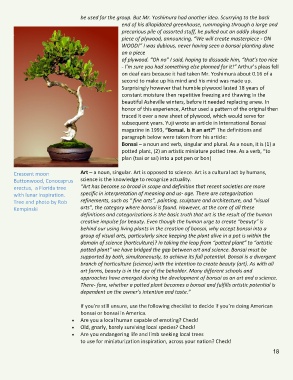
       Crescent moon               Art – a noun, singular. Art is opposed to science. Art is a cultural act by humans,
       Buttonwood, Conocaprus      science is the knowledge to recognize actuality.
       erectus,  a Florida tree    “Art has become so broad in scope and definition that recent societies are more
       with lunar inspiration.     specific in interpretation of meaning and us- age. There are categorization
       Tree and photo by Rob       refinements, such as “ fine arts”, painting, sculpture and architecture, and “visual
       Kempinski                   arts”, the category where bonsai is found. However, at the core of all these
                                   definitions and categorizations is the basic truth that art is the result of the human
                                   creative impulse for beauty. Even though the human urge to create “beauty” is
                                   behind our using living plants in the creation of bonsai, why accept bonsai into a
                                   group of visual arts, particularly since keeping the plant alive in a pot is within the
                                   domain of science (horticulture)? In taking the leap from “potted plant” to “artistic
                                   potted plant” we have bridged the gap between art and science. Bonsai must be
                                   supported by both, simultaneously, to achieve its full potential. Bonsai is a divergent
                                   branch of horticulture (science) with the intention to create beauty (art). As with all
                                   art forms, beauty is in the eye of the beholder. Many different schools and
                                   approaches have emerged during the development of bonsai as an art and a science.
                                   There- fore, whether a potted plant becomes a bonsai and fulfills artistic potential is
                                   dependent on the owner’s intention and taste.”


                                   If you’re still unsure, use the following checklist to decide if you’re doing American
                                   bonsai or bonsai in America.
                               •   Are you a local human capable of emoting? Check!
                               •   Old, gnarly, barely surviving local species? Check!
                               •   Are you endangering life and limb seeking local trees
                                   to use for miniaturization inspiration, across your nation? Check!

                                                                                                                   18

