


Page 17 - 2019 01 BSF Magazine_v3
P. 17
temperate trees the other artists in this article style. These species and their climate
                                   along with Rob’s unusual mix of left and right brain have enabled him to approach
                                   bonsai with a slightly different point of view. Rob adds: “Many countries across the
                                   world have adopted the Japanese word “bonsai” to define artistic dwarfed trees in
                                   pots. While the Japanese word popularized the art, bonsai has transcended beyond
                                   Japan to a global phenomenon, so do we really need to have the term American
                                   Bonsai? Can you capture the ethos of a nation in its art? Sure. Happens in every art
                                   form, but the operative word is art, and not the adjective. And so I would posit that
                                   the artistic goal is what is important and not so much the nationality. If the goal aims
                                   to capture the free spirit of the Nebraskan plains, the dankness of the Olympic rain
                                   forest, the antiquity of the Adirondacks, the tropical colors of Miami, or the
                                   abstractness of the American melting pot, the emotional content conveyed defines
                                   the art. If the art successfully conjures the emotion, and the feeling reminds one of
                                   America, then it is a success.
                                   When I style a tree, I set a design goal and then shape the tree to convey the telos.
                                   For example, I designed a tree planting as an eidetic of the novel “A Tree grows in
                                   Brooklyn.” But my goals aren’t always based on America. I’ve styled a fig tree to
                                   channel the Kraken, using the sea monster from Norse folklore for inspiration,
                                   another for a post apocalyptic Chinese wax factory, and others to reflect science
                                   fiction ideas and characters. To get around the connotation of bonsai or American
                                   bonsai, I have started to refer to what I do as tree art and not worry about
                                   categorization. So, if you want to have American Bonsai, then use an American ideal
                                   as your inspiration to style the tree.”


                                   Yuji Yoshimura as remembered by Arthur Joura
                                                                          and the author, Saimir Ogranaja
                                                                          I have attended a number or two, shy of a
                                                                          decade of classes from Arthur Joura. In one
                                                                          of these classes he brought in a handheld
                                                                          (albeit with several hands) miniaturized
                                                                          forest, planted on a large sheet of plywood.
                                                                          He told the story of how the planting came
                                                                          to be “In January of 1995 I was able
                                                                          to spend a brief period studying with Yuji
                                                                          Yoshimura at his home in Briarcliff Manor,
                                                                          NY, a highly memorable experience I regard
                                                                          as the most influential of my bonsai career.
                                                                          On that trip I had taken with me 25
                                                                          American Hornbeam, Carpinus caroliniana,
                                                                          trees in plastic nursery pots, 3 years from
                                                                          seed and completely untrained for bonsai
                                                                          use. On the final day of my stay Mr.
                                                                          Yoshimura used 17 of these trees to make a
                                                                          landscape planting. Along with the
                                                                          hornbeams, I had brought with me 2
                                                                          different stoneware trays, quality Tokoname
                                                                          containers, one of which I anticipated would

                                                                                                                   17
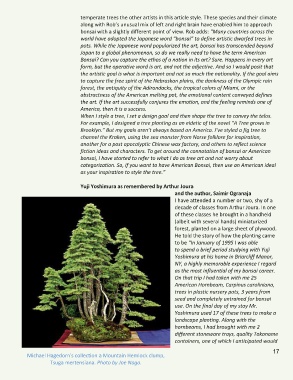
            Michael Hagedorn's collection a Mountain Hemlock clump,
                      Tsuga mertensiana. Photo by Joe Noga.

