


Page 13 - 2019 01 BSF Magazine_v3
P. 13
have the best possible grand opening weekend on Sept 2-3, 2018 of Eisei-En, his new
                                   nursery located outside of Nashville, TN. It was then that I realized that over the past
                                   (roughly) 10 years Bjorn has crossed boundaries in multiple areas. Bjorn spent six
                                   years as a full-time apprentice of Mr. Keichi Fujikawa, proprietor of Kouka-En Bonsai
                                   Nursery in Osaka, Japan, followed by 3 years as the first foreign-born, bonsai
                                   professional working in Japan. A talented musician, photographer, videographer,
                                   blogger, audio editor and video
                                   editor, all the while working on
                                   acquiring his PhD and studying
                                   what makes a proper fondue. OK
                                   I’m not sure about the fondue
                                   but the rest is all true. And luckily
                                   for us he adds to our bonsai in
                                   America discussion: Bjorn
                                   comments: “First, I’d like to say,
                                   as I travel around the world
                                   regularly, working with bonsai
                                   clients and groups in dozens of
                                   countries, the only place in which
                                   I’ve encountered this
                                   phenomenon of labeling bonsai

                                   by country is the United States. No
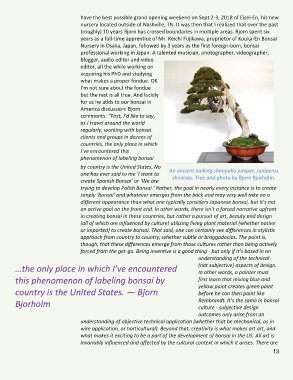
                                                                        An ancient looking shimpaku juniper, Juniperus
                                   one has ever said to me ‘I want to
                                                                         chinesas. Tree and photo by Bjorn Bjorholm.
                                   create Spanish Bonsai’ or ‘We are
                                   trying to develop Polish Bonsai.’ Rather, the goal in nearly every instance is to create
                                   simply ‘bonsai’ and whatever emerges from the back-end may very well take on a
                                   different appearance than what one typically considers Japanese bonsai, but it’s not
                                   an active goal on the front end. In other words, there isn’t a forced narrative upfront
                                   in creating bonsai in these countries, but rather a pursuit of art, beauty and design
                                   (all of which are influenced by culture) utilizing living plant material (whether native
                                   or imported) to create bonsai. That said, one can certainly see differences in stylistic
                                   approach from country to country, whether subtle or braggadocios. The point is,
                                   though, that these differences emerge from those cultures rather than being actively
                                   forced from the get-go. Being inventive is a good thing - but only if it’s based in an
                                                                                    understanding of the technical
       …the only place in which I’ve encountered                                    (not subjective) aspects of design.
                                                                                    In other words, a painter must
       this phenomenon of labeling bonsai by                                        first learn that mixing blue and
                                                                                    yellow paint creates green paint
       country is the United States. — Bjorn                                        before he can then paint like

       Bjorholm                                                                     Rembrandt. It’s the same in bonsai
                                                                                    culture - subjective design
                                                                                    outcomes only arise from an
                                   understanding of objective technical application (whether that be mechanical, as in
                                   wire application, or horticultural). Beyond that, creativity is what makes art art, and
                                   what makes it exciting to be a part of the development of bonsai in the US. All art is
                                   invariably influenced and affected by the cultural context in which it arises. There are
                                                                                                                   13

