


Page 36 - 2019 01 BSF Magazine_v3
P. 36
and twigs. Winter pruning helps clean up the past years growth and opens the tree. As sunlight hits the inner
branches, buds will open closer to the trunk. This leads to finer ramification. If not pruned judiciously, leaves will
extend at the end and deny sunlight and air from the dormant inner buds, leading to unattractive leggy growth.
Sometimes, a major branch critical to a design will get too thick for its position on the tree. If this is the case, it
must be pruned and the tree set-aside for a year or so just to regenerate.
In Florida, we enjoy an extremely short winter season. Our deciduous trees have only a few weeks with no
foliage. For instance, the Red Maples in the woods behind my house went only three weeks between leaf loss
and new buds appearing. Elms, Bald Cypress and Hackberry have only a few more weeks. If you are from the
north, this takes some getting used to. However, just before the buds break, i.e. now, is the time to act.
The first task is to decide if the branch structure remains according to the plan for the tree. Hidden within the
foliage cloud, some species can throw a surprisingly thick branch in one growing season. Typically, these are
sucker shoots that can weaken other well-placed branches. Remove all unnecessary thick branches that don't fit
the design. Prune them with a convex cutter to leave a nice mark that will heal over smoothly.
Next, critically examine each branch. Ask these
questions. When viewed from above, does the branch
mimic the overall design of the tree? Does it have
taper? Are there bar branches? Do branches point up
or straight down? Is the space between nodes short
enough? Do the branches continually ramify? Try this
with one of your trees. Pick a branch with good
ramification. Then start at the trunk and work out to
the tip of a branch. Count each time you hit a branch. A
well ramified tree should have at least seven levels of
ramification. Some old trees have over twenty.
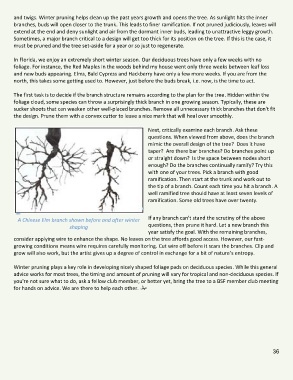
A Chinese Elm branch shown before and after winter If any branch can't stand the scrutiny of the above
shaping questions, then prune it hard. Let a new branch this
year satisfy the goal. With the remaining branches,
consider applying wire to enhance the shape. No leaves on the tree affords good access. However, our fast-
growing conditions means wire requires carefully monitoring. Cut wire off before it scars the branches. Clip and
grow will also work, but the artist gives up a degree of control in exchange for a bit of nature’s entropy.
Winter pruning plays a key role in developing nicely shaped foliage pads on deciduous species. While this general
advice works for most trees, the timing and amount of pruning will vary for tropical and non-deciduous species. If
you're not sure what to do, ask a fellow club member, or better yet, bring the tree to a BSF member club meeting
for hands on advice. We are there to help each other.
36

